Saturday, 28 July 2018

Barefoot Series: Part V - How I learned to go barefoot and love the forest

My foray into the world of barefoot running was not exactly straightforward. 

I like to think that I was gifted at running from a early age. I was a tall kid with long legs; a typical ectomorph build. Even though I was glued to my chair playing video games for a large portion of my childhood, I enjoyed giving 100% effort during gym class and the annual Terry Fox runs at school. As I grew older, my cardio was good but didn’t develop much beyond high school basketball and riding my longboard around town to buy snacks and smoke weed with my friends. One year during our annual Terry Fox run at school, our cross country coach saw my potential and recommended me to join the team, but I just wasn’t interested. Little did she know that she would plant a seed that would grow into a passion over time.

I mean I ran after school occasionally. Usually because I felt guilty that I ate too many cookies at lunchtime. It was only after growing out of my adolescence that I started to really have a vision of myself as an athlete. I needed to let go of my stoner identity and pursue what my intuition and heart was pointing me towards. I started running more, and over time I really began enjoying the process of pushing myself farther and faster. In the beginning there was a lot of trial and error. One of the ongoing issues I would experience was that my footwear was too small on one foot and I would get blisters. I was due for a new pair of shoes. Being already familiar with minimal shoes at the time, I was quite interested in giving them a shot. After trying on multiple pairs but failing to find the ‘perfect shoe’, I stumbled across Luna sandals at a running store called Distance Runwear in Vancouver. Wearing them provided a whole new level of freedom and increased sensory input. They began to change my life and running in profound ways.

High Knoll

I would get my first true taste of being barefoot in May 2016. One day I decided I would go for a walk in the woods after eating some psilocybin mushrooms. I packed my essentials in my backpack and I put on my sandals, which I had grown accustomed to, and embarked on what would become a beautiful trip. I slowly made my way to the top of a local hike. Having journeyed here many times before, this area was familiar to me. The sun was shining and I was comfortable, so it just made sense for me to take off my sandals and let my feet reconnect with the earth. The sunlit rocks were warm and inviting, and the varying textures of the ground beneath me provided me with a sense of stimulation I didn’t know I needed. After a brief meditation I was ready to make my way back home, the difference was I decided not to put my sandals back on and proceeded to hike the rest of the way down in my bare feet.


Luna Sandals - Oso Flaco

On my return journey I needed to slow down because the trail was littered with rocks and roots. As I placed each foot one after another with careful precision, I began to form a dialogue with the ground. I was the student, and the pathway of communication between the forest floor and my nervous system became my teacher. Traversing the path became a form of yoga. I was highly focused but at the same time it was as if I had unlocked an innate potential for effortless movement. The sensation of each step imparted me with wisdom; about my own body, about my place in nature, about my place as a human being experiencing the ongoing evolution of the cosmos. There was a sense of truth in going slowly, in letting go of any fear I had. I began to love the forest, and to feel at home. I was present, and that felt familiar and safe.

Following this experience I gained a new confidence in my feet and started running around the block barefoot. Soon my 1 kilometer runs developed into 3 kilometer runs, and then into 5 kilometers and so on. Over the seasons I developed my barefoot running and ‘found my sole’. I can now run over 10 kilometers at a time barefoot without any pain or blisters. I learned so much by just trusting my own body. I make sure that I revisit that trail annually to experience the pure joy and wisdom that I experienced 2 years ago. 

Sunday, 15 July 2018

Barefoot Series: Part IV


So you have made the decision to live a more barefoot lifestyle. Whether that's incorporating some barefoot running, walking to and from your mailbox, or going shoeless at the office. You are starting to notice the benefits; your posture is improving and your feet are getting stronger. However, we can’t be barefoot all the time. Highly technical trails, gravel roads, and even some city streets prove to be quite unforgiving surfaces for the barefoot traveler. Sometimes the temperature can be too extreme, whether it is too hot and the pavement is unbearable, or it is too cold and you start to put your feet at risk of frostbite. There are also cultural requirements that are set in place such as dress codes, e.g. when at work, eating out, and using public transit. If you have ever heard the term ‘no shoes, no shirt, no service’ then you are familiar with the cultural norms that unfortunately discriminate against the shoeless citizen, citing often that these rules are enforced because of ‘safety and sanitation’ reasons. If people washed their shoes as often as they showered I would understand, but it seems to me that shoes end up much dirtier than the average pair of feet. As for safety, the whole point of being barefoot is to walk around with greater control and awareness of your surroundings. Stubbing your toe or dropping a box on your foot whilst wearing sandals hurts just as much as being without them. Currently most public establishments mandate some sort of footwear. 

Shoes are indeed useful tools to have at our disposal. So in order to gain maximum benefit from all this time on our feet that isn’t barefoot we can wear shoes that mimic the barefoot experience as closely as possible. Over time all the hours spent being barefoot will cause your feet to change. They will get wider and more voluminous due to their increased muscularity. Footwear will seemingly get smaller as your feet grow bigger. You will become dissatisfied with the traditional selection of shoes at your local shoe store, for this reason I would recommend minimalist footwear.

To fall into the minimalist category, a shoe must adhere to the three commandments.


  • Thou shalt remain flat: Your feet do not have an elevated heel. The shoe should be flat so that you can move through your gait naturally and to discourage striking hard on the heel.
  • Thou shalt remain wide: Your feet are widest at the toes when you are born. The shoe should be widest at the toes of the foot to allow for maximum toe splay and stability.
  • Thou shalt remain thin: Your feet are full of nerves that require sensory input to function correctly. The shoe should be thin to allow to maximum feedback to encourage a light step and accurate proprioception (bodily awareness).


Hence the minimal shoe can be seen as the antithesis to the modern shoe. Instead of adding supposed functions like improving stability or reducing fatigue, minimal shoes are built to mimic being barefoot as closely as possible while still providing the benefits of wearing a shoe. The result is a shoe that has very little in the way of extra features. They can be thought of as the spiritual successors to the shoes of our ancestors. They are unforgiving, they won’t feel like walking on clouds, they won’t magically fix your gait, and they won’t make you faster. They won’t do any of these things because your comfort, biomechanics, and speed is highly dependent on you, the wearer, and your individual fitness level. However, they will protect against cuts and scrapes, offer thermal regulation, and allow you to make a fashion statement whilst adhering to cultural norms.

The general rule of thumb is that minimalist footwear is going to be a better option for letting your feet do their thing when compared to traditional footwear. So ideally you want to incorporate as much barefoot style footwear as possible. Similarly to the wide selection of running shoes and all their gimmicky features, there are many types of minimal footwear. Some are better than others, and some are merely imitators. They call themselves a minimal shoe or a barefoot shoe, but they are truly not. Minimal shoes adhere to the three commandments closely, they do not have a raised heel, a narrow toe box, or come with excess padding underfoot. 

There are styles for all occasions including sport, casual and formal wear. The trick is to slowly replace all of your lifestyle and sports shoes with a minimalist alternative so that you can maximize the benefits of going barefoot in any circumstance. We can take a look at some shoes that I have had the pleasure of trying and see how they fare in terms of adherence to the principles of minimalist footwear. 


Altra Shoes
Altra offers the widest toe box out of all the shoes listed here, but since they are shoes they just can’t quite mimic the freedom of boundless toe space. They have a flat sole to encourage proper biomechanics. However, they are quite thick (20mm+ sole) so they do not allow for a lot of feedback from the ground. These shoes are good for a beginner shoe to use alongside with truly barefoot training, they will allow your muscles, tendons, and ligaments to rest as you adapt to running barefoot.


Luna Sandals
Luna sandals are epic adventure sandals. No shoe comes close to offering the toe freedom that sandals do. They have a flat sole to encourage a proper bio-mechanics. They are thinner than Altras, and allow for a lot more feedback from the ground. However they are still quite thick (10mm+ sole) and thus will offer a lot more protection from difficult terrain. These sandals are useful over rough trails, longer or harder workouts, and simply walking around town. 


Xero Shoes
Xero shoes are wider than the average consumer shoe, but not wide enough to allow for full foot splay. *Their sandal option offers plenty of toe space like other minimalist sandals. They have a flat sole to encourage proper bio-mechanics. They remain very thin (5mm - 10mm sole) whilst still offering adequate protection from varying terrain. Their Xero Genesis huarache style sandal offers the most barefoot like feel out of every shoe mentioned here.


Vivobarefoot
The width of Vivobarefoot shoes vary from model to model. Overall they are wider than the average but not wide enough to allow for full foot splay. *I have yet to try them, but I presume their sandal option offers the same toe freedom as other minimalist sandals. They have a flat sole to encourage proper bio-mechanics. They are extremely thin (3mm - 5mm) but they have multiple models more suited to offering protection from difficult terrain. They are by far the best looking shoes on this list and they offer a wide range of models to choose from depending on your lifestyle.


There are many other models by other minimalist shoe companies that I have not had the chance to try, but I will link to their websites for those who are curious.

Shamma Sandals

Earth Runners

Joe Nimble

Bedrock Sandals

Lems Shoes

Softstar Shoes

Vibram Fivefingers


Saturday, 30 June 2018

Barefoot Series: Part III

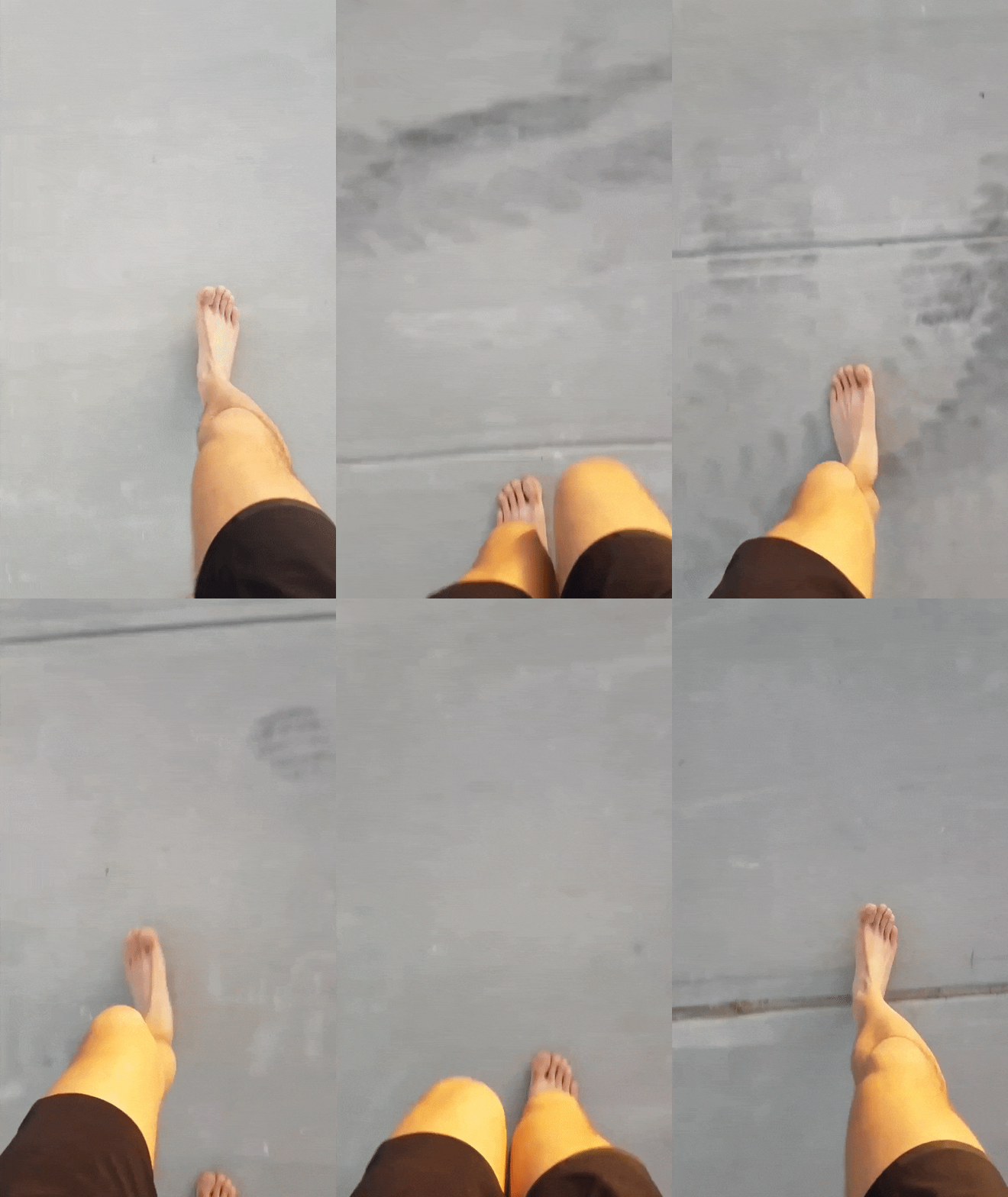
Running barefoot is the ultimate coach for learning to become a better runner. Just about any surface is suitable, but there are definitely beginner friendly surfaces for people entering the world with a fresh pair of feet. I would advise beginners to stay away from the grass as it just does not have the features to give you the necessary feedback to adjust your movement patterns. It is soft and allows you to make mistakes because almost no matter how you land it will feel comfortable on your feet. It is often the case that the softer the surface, the harder the impact. Whether you are walking around on pillows (cough… Hokas) or on soft grass, your feet want the feedback of a solid surface. You have to let the ground teach you.


One step at a time.
Moving along harder surfaces will allow you to adjust your movement style in order to minimize pain. In turn this will cause adaptations that will lead to smoother and less jarring impact forces on your knees, hips, and back. Contrary to popular belief, concrete is not only less dangerous than grass - it may be the safest way to start going barefoot. This is because concrete is smooth and predictable. You never know what is lying beneath the grass. You could risk a misstep and sprain an ankle, or worse, step in dog shit… With concrete you can see the obstacles ahead of you and avoid anything that may cause injury. The same principles that apply to grass apply when running on a sandy beach. There could be sharp objects underneath the soft surface, and moving along these soft surfaces is quite energy intensive. A short jog around the block of your local neighbourhood can teach you a lot. If it hurts, you may be doing something wrong. If you are getting blisters, you may be doing something wrong. If you are getting stress fractures, you may be doing something wrong… There are numerous ways to that you can learn from the pain you may experience when beginning your natural running journey. I have listed several cues to keep in mind.
  • Stand tall.
  • Engage the hips.
  • Be lighter on your feet.
  • Land with slightly bent knees.
  • Land closer to the middle of the foot.
  • Adopt a shorter stride.
  • Increase your running cadence.
If you focus on staying relaxed, increasing your cadence, and landing midfoot instead of landing heavily on the ball or heel of your foot, the rest of your running form should follow. Increasing your cadence simply means to shorten your stride length whilst maintaining the same speed. The magic number appears to be approximately 180 steps per minute. http://running.competitor.com/2014/07/training/make-a-high-stride-rate-work-for-you_54957 This may be a lot to think about, but any new skill will become automatic after you progress past the declarative and associative stages of learning. The key is not to think about how you are moving, but instead to feel how you are moving. You want to feel light, strong, and springy. You want to feel the flow. Blisters are usually a sign of excessive friction. To prevent blisters you can apply the same principles involved in minimizing impact forces. These means you want quick shortened strides - with your feet landing below your center of gravity and not in front of you. If your foot lands in front of you, you will tend to slide forward with each step instead of landing vertically. An important mental cue that I have found to help my running is to stand tall with a slight forward lean (dependent on pace) and imagine falling forward. In order to catch yourself from falling on your face you keep your momentum by lifting your feet using your hips and hamstrings as opposed to pushing off the ground using your glutes. The latter tends to increase contact time with the ground, which tends to increase friction, thus causing blisters.

You will develop callused feet in the beginning.

A certain level of thick skin does come with the territory. In the beginning you will be hypersensitive to any potential stick or stone you may step on. Increased padding on the foot along with a natural desensitization over time will makes things easier. You will experience neuromuscular adaptations over time causing your reaction times to decrease and allowing for effective redistribution of your weight to other parts of your feet quickly. But your main defense will be your technique — think of your feet “kissing” the ground gently with each step. Any new movement pattern requires an adaptation period for your muscles, joints and ligaments to grow stronger. Barefoot running is not something you want to muscle through. The initial discomfort you may experience is your body telling you to slow down. All too often there is the story of the person getting injured because they did too much too soon, myself included. Running without the traditional support of modern footwear will put more stress on your muscles and tendons — especially in your feet and ankles. Not to worry! Your body has evolved to be able to handle those stresses. Be prepared to develop jacked legs and feet. I would like to address the worries in regards to whether or not you lose cardiovascular endurance if you are starting from scratch. It is true that in the beginning you will only be running a couple hundred meters at a time if you want to learn to run barefoot and avoid injury while doing so. So if you have relied mainly on running for cardio, you may indeed lose some fitness. However there are things that you can do to keep progressing and actually help you to become an all around better athlete. Imagine you are learning to improve your push up technique. Your total number of reps may decrease, but so will your risk for injury. In the long run you will increase your strength gains by doing the movement with strict form. Sometimes it is a setback like an injury or the development of a new movement pattern that helps us get back to the basics, allowing us to improve upon our weaknesses and get over potential training plateaus. While your mileage is low you can incorporate more resistance and cross training into your schedule. I would recommend a combination of calisthenics, yoga, and cycling. Depending on your current fitness, diet, and lifestyle — you can expect to be back running 5 kilometer distances barefoot in 6 - 12 months time. Remember, consistency over time will yield results. You can even run barefoot on the side. However, this is not recommended because you will not be providing your body with the necessary stimulation to encourage a change in your running form. Every time you slip on a pair of traditional running shoes and go out on your usual run instead of running sans footwear, you risk slipping into bad running habits like long, heavy strides. This may keep you from losing endurance, but it will also take you a longer time to develop the habits necessary to increase your running economy (efficiency) and resistance to injury. You may still be skeptical that the easiest way to start is by running on concrete. Unfortunately there is not much I can do to convince you. You just have to get out there on the road and feel it to believe it. People have romanticized natural surfaces. At a glance natural surfaces like trails appear to be more comfortable. As an experiment go walk or run on a trail with variable surfaces including rocks and roots. Then continue running on the concrete — it will feel easy, even soft like a pillow! This is not because the ground has become softer or because your feet have been tenderized to a pulp, but because you have taken your approach to trail running back onto the road. Trails tend to have an overwhelming amount of sensory feedback, and with all of this feedback you are adjusting your gait step by step to accommodate your foot over the difficult terrain.


Natural surfaces shown above. Irregular and unpredictable, not exactly forgiving for bare feet.


Unnatural surfaces shown above. Smooth and predictable, perfect for a morning run. Mr. Bear says hi.


The whole point about running barefoot is learning how to move gently across the ground so you don’t pound yours knees and hips into a pulp by the time you are 50. This is about building a sustainable exercise habit that you can carry on into your 80’s. And it isn’t about being barefoot all the time. This is a practice to incorporate into your life to help you become more mindful about your bipedal locomotion. Shoes are tools that are helpful in cases where we want to protect ourselves from cuts and bruises. I will go into minimal shoes and why they are better for your feet than traditional shoes in the next blog. I know this may be a lot to take in, but for now don’t think about it too much. Go out, start slow, and experiment for yourself.


Saturday, 23 June 2018

Barefoot Series: Part II


At first going barefoot may remind us that we have lost one of our senses. That we must get back in touch with our natural biomechanics. Over time we are able to correct the muscular imbalances that form over a lifetime of wearing shoes and help reestablish a proper alignment and gait. As bipedal creatures, we have traversed this earth without the use of modern shoes for millenia. It is time that we nurture that primal part of ourselves. Overall, our health would be better off for it.

Being barefoot is a liberating experience — perhaps a little silly, but that’s the fun part. For example; if it is raining outside and you happen to step in a puddle it’s not that shitty of an experience. There are few things worse in the world than a pair of wet socks! In the journey to becoming a proficient barefoot runner you are unlearning old habits and getting back to the basics. These basic principles help build your fitness with a more solid foundation so that your development in running and other athletic endeavors can grow to new heights.


How can we start going barefoot without getting discouraged about the pain we may experience at first? A little context is important. Let us imagine a hypothetical scenario of a broken arm. In order to heal, our arm is placed in a cast to protect and immobilize the injury. After the injury has healed, if I were to visit my local gym and start lifting weights as if my arm was never broken I would experience all kinds of hell in the form of extreme delayed onset muscle soreness and an inability to use my arm for a week.


In much the same way our feet are placed in a cast for most of our lives in the form of shoes. If we want to continue running, walking, or even standing like we have without the artificial support of footwear. We should expect to experience a whole host of consequences when taking this cast off. Like with any new adventure we have to start slow, until we can build up a tolerance to the stimulation.


Sunday, 17 June 2018

Barefoot Series: Part I


The human foot is an engineering marvel — each foot contains 26 bones and over a hundred muscles, ligaments, and tendons. Second only to hands in sensitivity, the foot contains over 200,000 nerve endings, each of which provides us with crucial data for accurate movement and proprioception. As our ancestors descended from the trees, our feet evolved to be able to handle the variable surfaces on the ground below. It was on our feet that we walked thousands of kilometers through uncharted territory — finding new habitats and settling to become the people we are today. 

While it appears that footwear has allowed human beings to traverse across challenging surfaces and long distances, the majority of human migration was an undertaking that took place before the shoe was invented. Evidence suggests that primitive sandals were the earliest forms of supportive footwear, dating back to 30,000BC. In the northern regions, ancient humans used moccasin like footwear to insulate their feet from the snow. In most circumstances we were a barefoot people.

As society became more complex and man-made, shoes became the tool for enhanced style and bipedal locomotion. Eventually shoes became a cultural necessity, and walking barefoot was an activity reserved for poor or primitive people. Like all other man-made things shoes were subject to technological innovation. Several hundred iterations later the modern running shoe was invented and  later capitalized on by the likes of shoe brands like New Balance and Nike. Running shoe technology has improved but injuries amongst runners have remained the same. If the shoes are getting increasingly complicated, what metric determines their worth besides their increasing price? The faster race times that have been achieved in the last several decades were products of more effective training approaches and dietary regimes, and not the type of shoes you were wearing.

What's wrong with shoes?

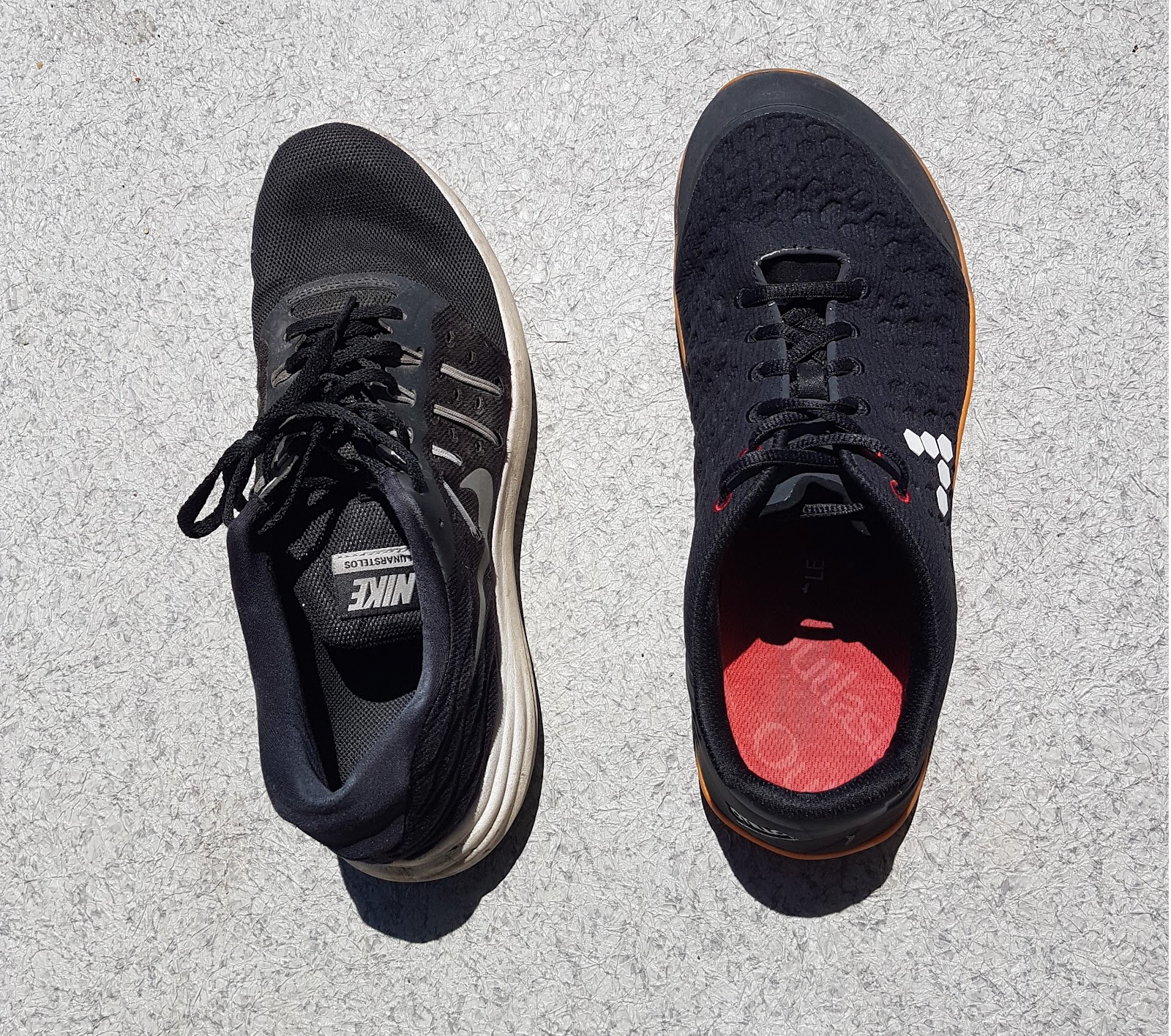
There are three problem areas in the modern shoe. The images below are intended to highlight these problem areas via a comparison between conventional running shoe and a minimalist running shoe (which I will go into more detail about later).

Elevated heel: An elevated heel on a shoe shifts your weight toward the ball of your foot, with your hips and knees following suit. This affects our posture and gait. Your back hyperextends backwards to compensate for this shift in centre of balance. It doesn't matter if you have Stilettos, Adidas Boosts, or Nike Frees. They all have some level of elevated heel and overtime you may develop muscular imbalances due to postural misalignment.

Thick sole: There is no practical reason for people to have thick pads at the bottom of their feet. This diminishes the flexibility of the shoe and limits your foots capability to adjust to each surface accordingly, encouraging higher impact forces. The raised footbed also increases the likelihood of ankle sprains.


Narrow toe box: Bunched up toes lead to bunions and blisters. You want your toes to spread out for maximum comfort and so your foot can form a natural tripod between your big toe, little toe, and heel, for maximum stability.


If we know what's wrong with shoes, what can we do about it? We can take them off and feel the ground beneath our feet once again.

Thursday, 18 February 2016

I choose life.


There is a small probability that I may not live to see tomorrow. There is a chance that I inherit a genetic disease and at the age of 50 I encounter inevitable health challenges. Heck, the odds of making it past the age of 85 don't seem to be stacked in my favor. I acknowledge the I cannot see that far into my future, thus I attempt to live my life day by day knowing that I am not invincible. But I still dream... that it is plausible that I will live indefinitely. And guess what? I want the same for you.

There is this romantic Kantian notion, that life is defined by its negative space. That every action you commit yourself to is ultimately decided and made meaningful in light of our ultimate destination. The thought that acceptance of our death ignites a flame and sets us in motion to achieve something before our time is up. And that if we had a longer lifespan, lets say 200 years of disease-free living for the sake of argument. That our urgency to live a life of purpose would somehow fade away.

I argue against the notion that "lifespans are long enough". And I suspect that many young people today would agree with me. But why? Is it that todays material based society has become vacuous and without meaning? That many of us feel unfulfilled and want to postpone the inevitable as long as possible to find some semblance of happiness? Is the desire to live forever somehow a selfish desire? I think the answer is simple, we are at a point in our history where we have the choice. Whereas other animals cannot alter their life expectancy like we can with advanced healthcare, superior hygiene, and better food choices. Saying lifespans are long enough, is like saying "you don't deserve to live past a predetermined age x". But who are we to determine what others want? Who are we to say how long the lifespans of future generations of human beings are. Who are we to limit scientific progress in the realm of age extension technologies? After all if you don't want to live longer you can simply avoid making certain lifestyle choices and avoid taking the eventual therapy required to extend lifespan.


The pro-death crowd will argue "overpopulation", without realizing that the rate of birth is a quadratic growth, which has a far greater effect on population than the rate of death which is linear. In most developing countries birth rate is decreasing, and I would assume with an aging population less people would be having kids effectively leading to zero-population growth. The pro-death crowd will argue that the greater number of old people will create a burden on the health care system without realizing that the goal is not to keep people sick and tired longer, but to keep them young and healthy longer. The pro-death crowd could respond by arguing that this will only widen the gap between the rich and poor, without realizing most of health care costs involve degenerative diseases caused by aging. If we could reduce or reverse the effects of metabolism, effectively combating aging and managed to reduce these diseases by 90 percent. We could save tremendously on health care costs and provide free anti-aging therapy to the population.

"AHAHAHAHAHAHAHAHAHA" the naysayer will say. "That is a pipe dream, your just smoking hella weed there is no way we would provide something like that for free! Are you crazy!?" Oh but before curling into the fetus position and crying myself to sleep in a ball of defeat. I have one last line of defense. What about all these free services...

  • sanitary water
  • libraries
  • public education
  • health care (Canada and Europe, sorry America)
  • welfare
  • parks
  • clean needles

With enough vision one can easily see how in the future where the needs of the people are met with increasing ease and efficiency due to technological progress, we can afford to make lives longer and better without cost to the individual.

It is not fun seeing relatives or strangers grow old and sick. It is no great life to be kept afloat in a nursing home or a hospital bed. I know of the Buddhist principle of impermanence and eventually all things will end in entropy; the eventual heat death of the universe or something equally as dismal and sad. These facts are unavoidable. But I am not arguing to extend life for no reason, I am arguing that life is worth living as long as possible. I want to see us explore the stars. I want to experience the amazing transcendental worlds created in virtual reality. I want to see artificial general intelligence eventually evolve into a super-intelligence in the supposed technological singularity and change the world in ways unimaginable to even the brightest minds today. I want you to see it too.

Here is an excerpt from the poem by Dylan Thomas, remember these words.


"Do not go gentle into that good night.

Rage, rage against the dying of the light."

Do what you can, fight even, for your right to have a life as long and healthy as possible because its all you have and all you ever will have.


Wednesday, 17 February 2016

Cannabis vs. Alcohol?


It is probably the case that most regular people will not consider much of a difference between cannabis and alcohol in terms of which one they should consume. If anything most people consider alcohol as the lesser of the two 'evils'. Perhaps due to the fact that alcohol consumption is ubiquitous to almost all cultures. Whereas cannabis consumption, due to its illegality has become somewhat of a subculture. Although it is making a comeback in recent years due to legalization efforts in countries like Uruguay. And the acceptance of its many medical applications in North America, Europe, and other countries around the world.

I am not going to pretend that I do not have an agenda, I do. I want to help my readers realize just how stupid it is to compare cannabis to alcohol, and in fact show that it is better placed somewhere between non-alcoholic beer and coffee. The very fact that cannabis is often paired with coffee as a way to jump start ones creativity and productivity should make this very obvious. Some progressive workplaces even go so far as to allow cannabis consumption at the workplace. Here are two reasons why cannabis is safer than alcohol and more like coffee.

1. LD50

The LD50 means the dose of an ingested substances at which 50 percent of the the subjects die. Cannabis effectively does not have an LD50. A smoker would theoretically have to consume nearly 1500 pounds of cannabis within fifteen minutes to induce a lethal response. You would die from carbon monoxide poisoning before dying from an overdose of THC. In fact, no one has ever died from cannabis alone. On the other hand the Centre for Disease Control and Prevention has the stats on alcohol at approximately 29,001 deaths from alcohol in the US alone, excluding accidents and homicides. Elizabeth Warren is a US senator who has recently called for the legalization of cannabis to help curb America's opiod addiction crisis.

And then no offense, but the pompous uneducated crowd thumps their chest and yells "But what about being high and driving!?" Well... that is no longer up for debate as there is proof that driving under the influence of cannabis is significantly safer than driving under the influence of alcohol. And this is a non issue in the near future where nearly all densely populated roadways will be occupied by self-driving cars.

2. Health

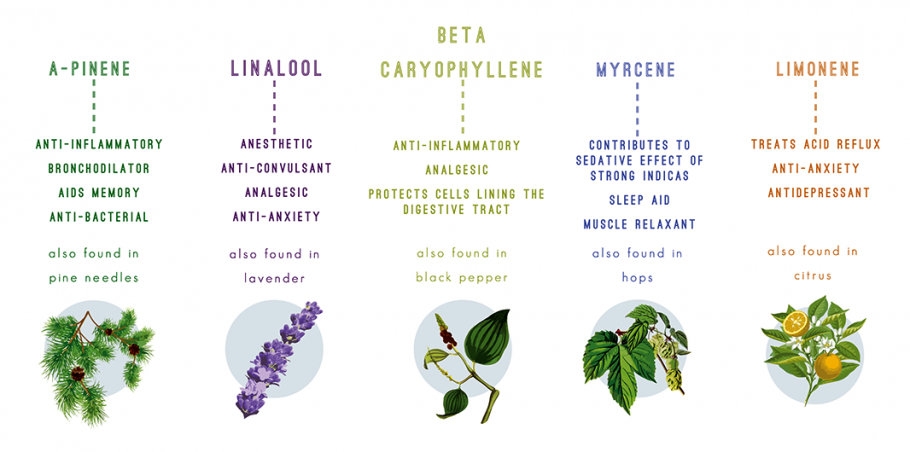
Cannabis is significantly safer than alcohol. Alcohol has 7 calories per gram, and cannabis has none. Cannabis has recognized as having multiple medical uses including the treatment of cancer. Whereas alcohol consumption is linked to causing certain types of cancer. Cannabis smoking is only linked to upper respiratory tract problems, but not linked directly to causing cancer. And who is smoking cannabis nowadays? Vaporizing has become affordable and is much safer, cleaner, and more effective than smoking the plant. You avoid the taste of burnt plant matter and the buildup of resin and tar in the lungs. New methods in essential oil extraction have turned the world of cannabis upside down in terms of contaminant free material. All you are getting with some of these oils is the cannabinoids and there associated terpenes which have their own benefits.


I don't recommend using cannabis unless it helps you function better or relax. But to lump it in the same category as alcohol is making a huge mistake. Cannabis and other psychedelics help to increase openness to experience. Maybe that is just what we need to reignite our humanity and rekindle our long lost relationship with this plant and others. I don't even use cannabis daily but I know from personal experience that it can...

  • rekindle your relationship with nature
  • make you anxious about all your superficial insecurities
  • heighten your sexuality
  • increase appetite and appreciation of food
  • increase suspension of disbelief
  • relax musculoskeletal system
  • widen your musical taste
  • promote creative thinking
  • aid in digestion
  • help sleep
Of course it can also lead to...

  • time spent 
  • money spent
  • paranoid thinking
But those are only a subset of the negative effects of alcohol which also include...

  • vomiting
  • dying
  • poor decision making
I could have written a more exhaustive article, but I realize at this point it is not the lack of information about cannabis that is preventing people from making this connection. Those who still believe in the idea of the 'devils lettuce' are willfully ignorant, and perhaps this time around are indeed on the wrong side of history.